
A GLOBAL TOUR OF SEWING ANTIQUES
A GLOBAL TOUR OF SEWING ANTIQUES
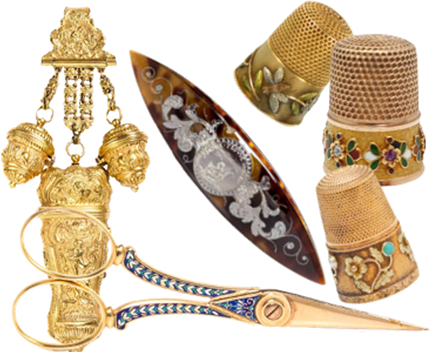
Just like food or fashion, every country had its own sewing tool style. Here’s how to spot some of them:
Know Your Country’s “Signature”
- America – Sterling silver and gold thimbles with Art Deco, eagle or floral motifs; souvenir thimbles, tape measure, and pincushions.
- England – Sterling silver thimbles, needle cases, thread winders, and more.
- France – Silver and gold thimbles, fitted boxes, needle cases and of course Palais Royal! Some French sewing tools have a bust of Napoleon – a big hit with collectors! Intricate Prisoner of War straw work boxes and needle cases are highly sought after.
- Germany – Precision-made scissors; silver and enamel banded thimbles, many marked with the 8-pointed star trademark; carved wood thimble holders, and more.
- Norway – Rosemaling (folk art) designs, enameling on thimbles and etuis.
- Russia – Colorful enamel, Niello and intricate filigree work on thimbles and tools.
The origins of antique and vintage collectible sewing or needlework tools are truly global, reflecting the universal human need for clothing and textiles, as well as the unique cultural and technological advancements of different regions. Here’s a look at some key countries and why they excelled.
1. China:
- Early Innovations: China boasts some of the earliest evidence of sophisticated sewing tools. Bronze thimbles from the Han Dynasty (206 BC – 220 AD) have been found within tombs, indicating advanced metalworking and the importance of sewing. The earliest known metal thimble was also found in China.
- Silk Road Influence: China’s mastery of silk production and embroidery meant that fine needles and specialized tools were essential. The Silk Road (around 130 BC – 1450 AD) likely facilitated the spread of Chinese sewing techniques and tool designs westward.
- Artistic Sewing Boxes: In the 19th century, China produced exquisite sewing cabinets and work boxes, often made for export to Europe and America. These were frequently made from lacquered wood, sometimes inlaid with mother-of-pearl, and contained carved ivory or bone tools, reflecting a high level of craftsmanship and an understanding of the European market’s desire for exotic and beautiful items
2. Germany (especially Nuremberg):
- Medieval Thimble Hub: Nuremberg became a prominent center for thimble production in the 15th and 16th centuries. Its well-organized brass casting industry and skilled “free tradesmen” (thimble makers) produced high-quality brass thimbles that were exported widely.
- Metalworking Expertise: Germany’s long history of metalworking, particularly in brass and later steel, gave it a natural advantage in producing durable and finely crafted sewing tools.
- Later Innovations: German manufacturers continued to be significant in the 19th and 20th centuries, producing not only thimbles but also sewing machines (e.g., Pfaff, Gritzner), sewing and embroidery scissors and quality needles.
3. England:
- Early Metal Thimble Production: While some early thimbles were imported from Nuremberg and Holland, England developed its own significant thimble production, particularly after John Lofting, a Dutch manufacturer, established a factory in London in the late 17th century. The use of water power boosted output.
- Industrial Revolution Powerhouse: The Industrial Revolution, originating in England, dramatically transformed sewing tool production.
- Factories in places like Birmingham began mass-producing thimbles, pins, and other small metal articles.
- Redditch became world-famous for its high-quality needle production from the 17th century onwards, eventually churning out millions of needles per week with the aid of machinery. The availability of water power for scouring mills was a key factor.
- English inventors, like Thomas Saint (1790) and John Fisher (1844), were crucial in the early development of sewing machine designs, though American inventors later commercialized them more widely.
- Victorian Craze: England was at the heart of the Victorian thimble collecting craze. The Great Exhibition of 1851 led to the creation of many commemorative thimbles, and English companies, like Charles Horner (famous for his “Dorcas” thimbles), produced iconic designs.
- Specialized Scissors: Sheffield, known for its cutlery, also produced distinctive sewing and embroidery scissors, often with gold-plated handles shaped like storks or owls.
4. France:
- Artistic Flair and Luxury Goods (especially Palais Royal): France, particularly the workshops around the Palais Royal in Paris during the late 18th and 19th centuries, was renowned for producing exquisitely crafted luxury sewing necessaires (work boxes) and individual tools. These were often made from precious materials like gold, silver, mother-of-pearl, ivory, and tortoiseshell, often adorned with miniature paintings, intricate inlays, and delicate enameling.
- Fashion Influence: As a global center of fashion, France naturally fostered a demand for beautiful and refined tools for dressmaking and embroidery among the aristocracy and wealthy.
- Early Sewing Machine Development: Barthelemy Thimonnier patented one of the first successful sewing machines in 1830, initially for military uniforms, though its adoption faced resistance.
5. United States:
- Mass Production and Innovation: While not having as ancient a history of sewing tool production as European or Asian nations, the U.S. became a powerhouse in the 19th century due to its rapid industrialization and a strong spirit of innovation.
- Sewing Machine Dominance: American inventors like, Elias Howe (lockstitch machine) and Isaac Merritt Singer (who vastly improved and popularized the sewing machine with a foot treadle), revolutionized home sewing and industrial garment production. Companies like Singer became globally recognized.
- Practicality and Affordability: American manufacturers focused on efficient, mass-produced tools that were accessible to a broader market, contributing to the widespread adoption of home sewing.
- Whaling Industry By-products: Early American thimbles sometimes utilized unique materials like whale bone or tooth, often featuring scrimshaw designs, particularly in New England whaling towns.
Why these countries excelled:
- Access to Resources: Proximity to essential raw materials, like copper, zinc (for brass), iron, and later steel, was crucial for metalworking.
- Skilled Artisans and Guilds: Established traditions of craftsmanship, often organized into guilds, ensured the passing down of specialized skills and high standards of quality.
- Technological Advancement: Countries that embraced new technologies, particularly during the Industrial Revolution (e.g., water power, steam power, machine tooling), could produce goods more efficiently and in larger quantities.
- Economic Prosperity and Demand: Wealthier nations with growing middle classes created a demand for both utilitarian and luxurious sewing tools. As clothing became more elaborate and accessible, so did the need for tools to create and maintain it.
- Trade and Export Networks: Nations with strong trade routes and colonial empires could easily distribute their manufactured goods globally, establishing their reputation.
- Cultural Significance of Sewing: In many of these societies, particularly in the Victorian era, sewing was not just a practical skill but a central part of domestic life, a sign of female accomplishment, and a vehicle for artistic expression, further driving demand for diverse and beautiful tools. Website-Global Tour.
The story of antique and vintage sewing tools is, therefore, a microcosm of global economic, technological, and cultural history.
The 2026 Convention was held in San Antonio, Texas, and it was a great deal of fun.
On 16 January 2021, TCI held its first member ZOOM meeting. A short business meeting was followed by a program titled “The One That Got Away” meaning the entire year of 2020! The program was based on a fish theme. Members in attendance enjoyed visiting with their fellow collectors from around the world. Our next Zoom will be on 14 November 2026. The Zoom meeting always includes an education program and an auction.
NEW! CONNECT WITH US! Do you have Facebook or Instagram? Follow Thimble Collectors International on Facebook https://www.facebook.com or Instagram https://www.instagram.com Click [here] for the QR codes which you can scan for easy access to TCI Facebook and Instagram.
The HISTORY OF TCI can be viewed here. This is a history of how thimble and needlework tool collectors joined to share their common interests, first by correspondence and then by meeting in local groups. This led to the formation of TCI. The information was initially written in 1998, but as with any organization, we continue to grow and the history must be expanded upon and updated. TCI holds a convention every two years in different cities around the USA.
The TCI BULLETIN, the organization’s newsletter, is produced four times a year. It is filled with informative articles about needlework tools, thimbles, and other helpful information for the collector. The TCI Bulletin is printed with full-color images and mailed 1st Class Mail in a protective plastic sleeve. A sample of a past Bulletin issue can be viewed [here]
We share with you an excellent program that was presented at a past convention by Charter member, Virginia Weaver. The program is titled “Fact or Fancy” (Click on the title to view the PDF version of this program.) All past Bulletin issues are available to read or download on the Member’s Only side of our website. An A-Z 1978-2025 Index of Bulletin articles can be found by clicking here. All bulletin back issues can be found on the Member’s Only side of the website.

Left: Fern Ware Pin Disc, circa the 1800s. Middle: Thimble Collage. Right: Straw Work Needle Box.
The Internet has changed the organization and we have expanded our horizons. The official TCI website continues to grow and in 2010 a MEMBERS ONLY section was introduced. This part of the website is filled with an abundance of information. Research files that include both needlework tools and thimbles, Price Guides, data and image files on Fakes & Reproductions, Hallmarks & Maker’s Marks, historical data about TCI, Club/Group/Society thimbles, TCI thimbles, TCI enameled pins, Meissen, our Charter Members, and their collections, Series Documentation, TCI Rental Programs (being reworked), a Digital Library, and so much more. As a member of TCI, you benefit from the information shared. We invite you to join TCI today! For more information about TCI, contact Membership.