
ORIGINS OF ANTIQUE COLLECTIBLE THIMBLES AND SEWING TOOLS
Origins Of Antique Collectible Thimbles And Needlework Tools
WHAT ARE THE ORIGINS AND BACKGROUND OF ANTIQUE & VINTAGE COLLECTIBLE THIMBLES AND NEEDLEWORK TOOLS?
The history of thimbles and needlework tools is long and fascinating, stretching back tens of thousands of years. Thimbles were used as early finger protectors for sewing. Their evolution from utilitarian tools to sought-after collectibles is a story of changing materials, manufacturing techniques, cultural significance, and artistic expression.
Origins as a Practical Tool:
- Ancient Roots: The earliest forms of finger protection for sewing are believed to date back as far as 30,000 years with finds of bones used by mammoth hunters. Evidence of specifically fashioned sewing instruments, including a simple ring-shaped thimble, has been found from the Han Dynasty in ancient China (206 BC–202 AD). Bronze thimbles from the Roman Empire (1st century AD) have also been discovered.
- Early European Use: While some very early examples exist, thimbles became more widespread in Europe by the 14th century. Medieval thimbles were typically made of brass, either cast or hammered from sheet metal. Their indentations were initially hand-punched, leading to irregular patterns.
- Materials Evolution: Throughout history, thimbles have been crafted from a diverse range of materials, reflecting available resources and technological advancements. These include bone, horn, ivory, whalebone, leather, wood, stone, bronze, brass, and later, silver, gold, porcelain, glass, rubber, and various metal alloys.
The Rise of Collectible Thimbles:
- Symbol of Status and Gift-Giving (16th-18th Centuries): As thimble-making advanced, particularly in centers like Nuremberg and later Holland and England, they began to take on more decorative forms. Silver and gold thimbles became popular gifts for ladies symbolizing wealth and status. Some were adorned with intricate designs, engravings, and even gemstones for royalty and the wealthy. Commemorative thimbles also started to appear, marking important events.
- Victorian Era and the “Digitabulist” Craze (19th Century): The Victorian era saw a significant surge in the popularity of thimble collecting (known as “digitabulism”). This was fueled by several factors:
- Needlework as a Pastime: Needlework became a widespread and fashionable activity for women, increasing the demand for thimbles and tools.
- Industrial Revolution: Mass production ‘thanks to industrialization’ made thimbles more accessible and varied.
- Great Exhibition of 1851: The Great Exhibition in London’s Crystal Palace spurred the creation of numerous souvenir thimbles, further popularizing them as collectible items.
- Innovation: Charles Horner’s “Dorcas” thimble, with its steel core and silver exterior, solved the problem of soft silver wearing down, creating a durable and attractive option that remains popular with collectors today.
- Decorative Variety: Thimbles became increasingly elaborate, featuring miniature paintings, sentimental inscriptions, and a wide array of patterns and materials like porcelain and glass.
- 20th Century and Beyond: Thimble collecting continued to grow in the 20th century. Companies produced limited-edition and commemorative thimbles for events, places, and advertising. Royal Worcester and Wedgwood were notable producers of highly sought-after porcelain thimbles. Today, collectors often specialize in particular eras, materials, or manufacturers, seeking out rare and unique pieces that reflect historical significance, craftsmanship, and artistic expression.
In essence, antique and vintage collectible thimbles have a dual identity. They were once essential tools for a fundamental human activity (sewing), and over time, they transformed into miniature works of art and historical artifacts that tell stories of changing technologies, social customs, and aesthetic tastes.
WHAT ARE THE ORIGINS AND BACKGROUND OF ANTIQUE & VINTAGE COLLECTIBLE THIMBLES AND NEEDLEWORK TOOLS?
The origins of antique and vintage collectible sewing tools are deeply intertwined with the very beginnings of human ingenuity and the fundamental need for clothing and textiles. From the earliest protective finger coverings to elaborate sewing machines, these tools reflect millennia of technological, social, and artistic evolution.
Early Origins (Pre-Historic to Medieval):
The material of an antique sewing tool can tell you how old it is, where it’s from, and even how wealthy its owner was!
- Necessity is the Mother of Invention: The earliest forms of sewing date back tens of thousands of years to the Paleolithic era. As humans began to wear animal hides for warmth and protection, the need to join these materials together became crucial.
- Bone and Ivory Needles: The very first “needles” were likely made from sharpened bone, antler, or ivory. The oldest known bone needle, found in South Africa, is approximately 60,000 years old. These early tools would have been used with “thread” made from animal sinew, plant fibers, or gut.
- The Eye: A significant development was the introduction of needles with a hole at the top to accommodate the gut or thread, appearing around 25,000 BC. This allowed for more effective and precise stitching.
- Thimbles: As discussed previously, early thimbles, or finger protectors, emerged alongside needles to aid in pushing them through tough materials. Bronze thimbles from Roman times (1st century AD) have been documented.
- Metal Needles and Pins: By the 14th century, iron needles became more common in Europe, followed by the widespread use of steel. Pins, also essential for holding fabric, evolved from simple fasteners of bone or metal to more refined forms with decorative heads.
- Basic Tools: During this period, sewing kits would have been relatively simple, consisting of needles, thimbles, and possibly simple cutting tools like shears (though modern pivot-type scissors weren’t common until the Roman era).
The Decorative and Functional Era (16th to 18th Centuries):
- Status Symbols: As society became more stratified, sewing tools began to reflect status. Wealthy individuals commissioned tools made from precious metals, like silver and gold, often intricately engraved or adorned with gemstones.
- Specialized Tools: While hand sewing remained the norm, more specialized tools began to appear for specific tasks, though many remained quite rudimentary compared to later developments.
- Sewing Boxes and Cases: To protect these valuable and often beautiful tools, decorative sewing boxes (also known as work boxes or necessaires) and cases emerged. These could be elaborate, made from fine woods, inlaid with mother-of-pearl, or lined with silk and velvet, and often contained fitted compartments for various implements.
The Golden Age of Collectibles (Victorian Era – 19th Century):
- Industrial Revolution Impact: The 19th century was a transformative period. The Industrial Revolution led to:
- Mass Production: This made sewing tools more affordable and widely available to the middle classes.
- Innovation: New technologies allowed for more intricate designs and the use of new materials.
- Sewing Machine: The invention of the sewing machine in the mid-19th century by inventors like Elias Howe and Isaac Singer revolutionized garment production, first in factories and then in homes. While machines themselves became collectibles, the hand tools still used alongside them also flourished.
- Variety and Novelty: This era saw an explosion of diverse and often whimsical sewing tools. Beyond basic needles, thimbles, and scissors, collectors can find:
- Pincushions: From simple stuffed cushions to highly decorative forms shaped like shoes, animals, or miniature furniture.
- Needle Cases/Keepers: Elaborate containers to protect precious needles, often made from bone, ivory, brass, silver, gold, or highly decorated wood.
- Tape Measures: Often found in figural forms, such as animals, household objects, or advertising novelties.
- Bodkins: Blunt, thick needles used for threading ribbons or elastic through casings.
- Stilettos/Awls: Pointed tools for piercing holes in fabric or leather.
- Thread Winders: Used to store thread that was sold in skeins, rather than spools.
- Crochet Hooks: Used to create clothing, linens, and decorative trims, the hooks often made of carved bone or ivory, sterling silver, gold, or with gemstone handles.
- Sewing Birds/Clamps: Decorative metal clamps (often bird-shaped) that attached to a table to hold fabric, acting as a “third hand.”
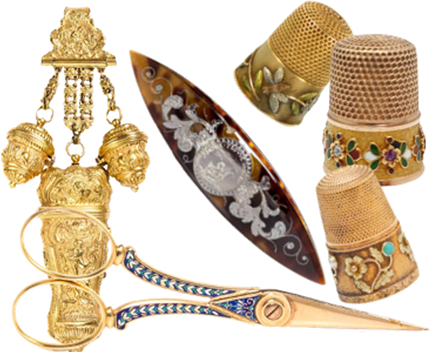
- Chatelaines and Etuis: Decorative belt hooks (chatelaines) or small, ornamental cases (etuis) designed to hold a collection of miniature sewing tools, allowing ladies to keep their essentials close at hand.
- Artistic Expression: Even utilitarian items were often beautifully crafted, featuring ornate handles, engravings, and various decorative techniques. The skill and artistry involved in making these tools contributed to their appeal.
- Sentimental Value: Sewing and embroidery were a central part of domestic life for women, and these tools were often cherished gifts, passed down through generations, acquiring sentimental value.
Why are they collectible today?
- Historical Connection: They offer a tangible link to the past, providing insights into daily life, domestic practices, and the evolution of technology.
- Craftsmanship and Beauty: Many antique and vintage sewing tools are miniature works of art, showcasing exquisite craftsmanship, intricate detailing, and beautiful materials.
- Variety: The sheer diversity of types, styles, materials, and origins means there’s always something new to discover, appealing to various collecting interests.
- Nostalgia: For many, they evoke a sense of nostalgia for simpler times or connect to family history.
- Practicality: While many are collected for display, some are still perfectly usable, especially quality hand tools like scissors.
In summary, antique and vintage collectible sewing tools represent a rich tapestry of human history, reflecting both practical necessity and artistic endeavor, making them a popular and enduring area of collecting.
JOIN IN ON THE FUN! MEET FELLOW COLLECTORS OF THIMBLES AND NEEDLEWORK TOOLS FROM AROUND THE WORLD! The 2026 Convention will be held in San Antonio, Texas. Dates are 16-19 September 2026. Registration is now OPEN.
On 16 January 2021, TCI held its first member ZOOM meeting. A short business meeting was followed by a program titled “The One That Got Away” meaning the entire year of 2020! The program was based on a fish theme. Members in attendance enjoyed visiting with their fellow collectors from around the world. Our next Zoom will be on Saturday 25 July 2026. The Zoom meeting always includes an education program and an auction. The program will be presented by Jenny Bockel (South Africa) and it is titled “A Family Legacy. Thimble and Miniature artists – Fay, Angie & Charmaine. Cape Town, South Africa.”
NEW! CONNECT WITH US! Do you have Facebook or Instagram? Follow Thimble Collectors International on Facebook https://www.facebook.com or Instagram https://www.instagram.com Click [here] for the QR codes which you can scan for easy access to TCI Facebook and Instagram.
The HISTORY OF TCI can be viewed here. This is a history of how thimble and needlework tool collectors joined to share their common interests, first by correspondence and then by meeting in local groups. This led to the formation of TCI. The information was initially written in 1998, but as with any organization, we continue to grow and the history must be expanded upon and updated. TCI holds a convention every two years in different cities around the USA.
The TCI BULLETIN, the organization’s newsletter, is produced four times a year. It is filled with informative articles about needlework tools, thimbles, and other helpful information for the collector. The TCI Bulletin is printed with full-color images and mailed 1st Class Mail in a protective plastic sleeve. A sample of a past Bulletin issue can be viewed [here]
We share with you an excellent program that was presented at a past convention by Charter member, Virginia Weaver. The program is titled “Fact or Fancy” (Click on the title to view the PDF version of this program.) All past Bulletin issues are available to read or download on the Member’s Only side of our website. An A-Z 1978-2024 Index of Bulletin articles can be found by clicking here. All bulletin back issues can be found on the Member’s Only side of the website.

Left: Fern Ware Pin Disc, circa the 1800s. Middle: Thimble Collage. Right: Straw Work Needle Box.
The Internet has changed the organization and we have expanded our horizons. The official TCI website continues to grow and in 2010 a MEMBERS ONLY section was introduced. This part of the website is filled with an abundance of information. Research files that include both needlework tools and thimbles, Price Guides, data and image files on Fakes & Reproductions, Hallmarks & Maker’s Marks, historical data about TCI, Club/Group/Society thimbles, TCI thimbles, TCI enameled pins, Meissen, our Charter Members, and their collections, Series Documentation, TCI Rental Programs (being reworked), a Digital Library, and so much more. As a member of TCI, you benefit from the information shared. We invite you to join TCI today! For more information about TCI, contact Membership.